
Perrysburg City Directory Collections
Way Public Library is the core local stop for a Perrysburg directory search. The inspected collection describes local telephone directories, House History Files, newspaper and obituary files, church and cemetery material, maps, atlases, photographs, family histories, and Perrysburg High School yearbooks. The sources do not identify a complete printed local publisher or a verified shelf run. That gap matters. Treat the holdings as dated local evidence, not as a promise that each year or each address appears in one book.
| Collection | Known coverage | Where held | Access route |
|---|---|---|---|
| Local telephone directories | Volume years not published in inspected sources | Way Public Library Local History Collection | Local collection and electronic-history route |
| Local newspaper name and subject index | Begins 1836 | Way Public Library | Index, digitized newspapers, and physical research |
| Way Digital Archive | Varies by item | Ohio Memory and Way Library | Searchable online collection |
| Exchange Hotel registers | Beginning 1865 | Way Collection | Local-history research |
| Perrysburg High School yearbooks | Years not published in inspected sources | Way Public Library | Local History Collection |
Start with the record type that fits the date. A telephone listing can provide a listed subscriber and address. A newspaper item may add a date or family connection. A House History File is organized around an address. Each needs its own citation and date.
Perrysburg Historical Evidence at Way
The Way Public Library Local History Collection provides the best local companion material when a formal directory volume is incomplete or unavailable. Ask for the relevant telephone-directory volume, House History File, map or atlas, and newspaper-index entries for the exact address or surname. The library also identifies local church and cemetery records, a local obituary file, yearbooks, photographs, and family histories. These materials can test an entry without turning one printed listing into a full household roster.
The Way Library collection page is shown in this Perrysburg local-history research image.
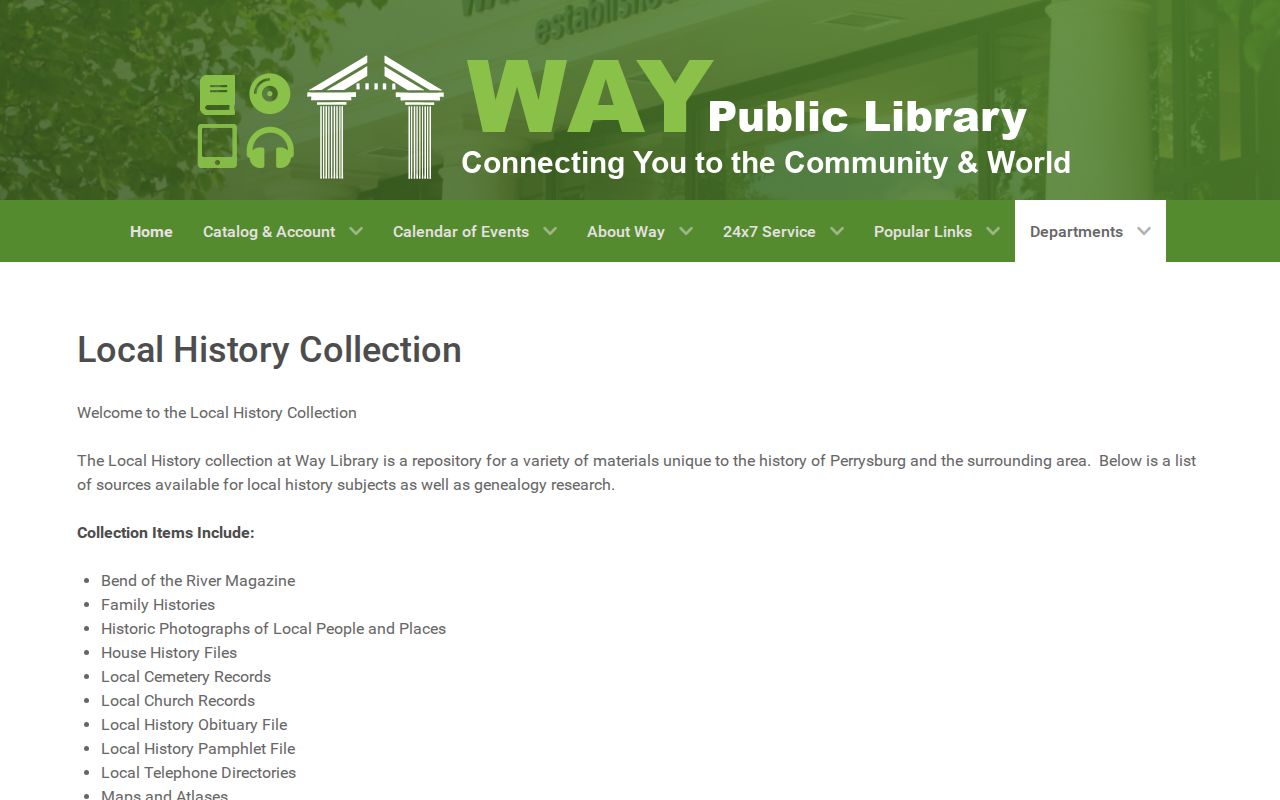
Its collection list is a useful request checklist for a name or address, especially when the date of a telephone directory is known.
Way Library began as a community library in 1881 and has stood at its current location since 1892. That continuity helps explain why its local material reaches beyond a single telephone-book format. Note: a local telephone book normally identifies the listed service subscriber, not every person connected to an address.
Perrysburg Directory Newspaper Names
A dated Perrysburg directory entry becomes more useful when a newspaper result supports it. Way's local newspaper name-and-subject index begins in 1836. Verified title spans include Ohio Whig, 1839-1840; Perrysburg Journal, 1853-1861; Weekly Perrysburg Journal, 1861-1866; Perrysburg Weekly Journal, 1866-1868; and Perrysburg Journal, 1868-1965. Those spans identify titles, not a guarantee that every issue is searchable online.
Search the library index first. Then save the title, issue date, and page with any address or name. A notice can distinguish two similar names or show that a family was connected to Perrysburg at that moment. It should not be read as proof of an uninterrupted residence.
The Way electronic local-history gateway is pictured here for Perrysburg city directory research.
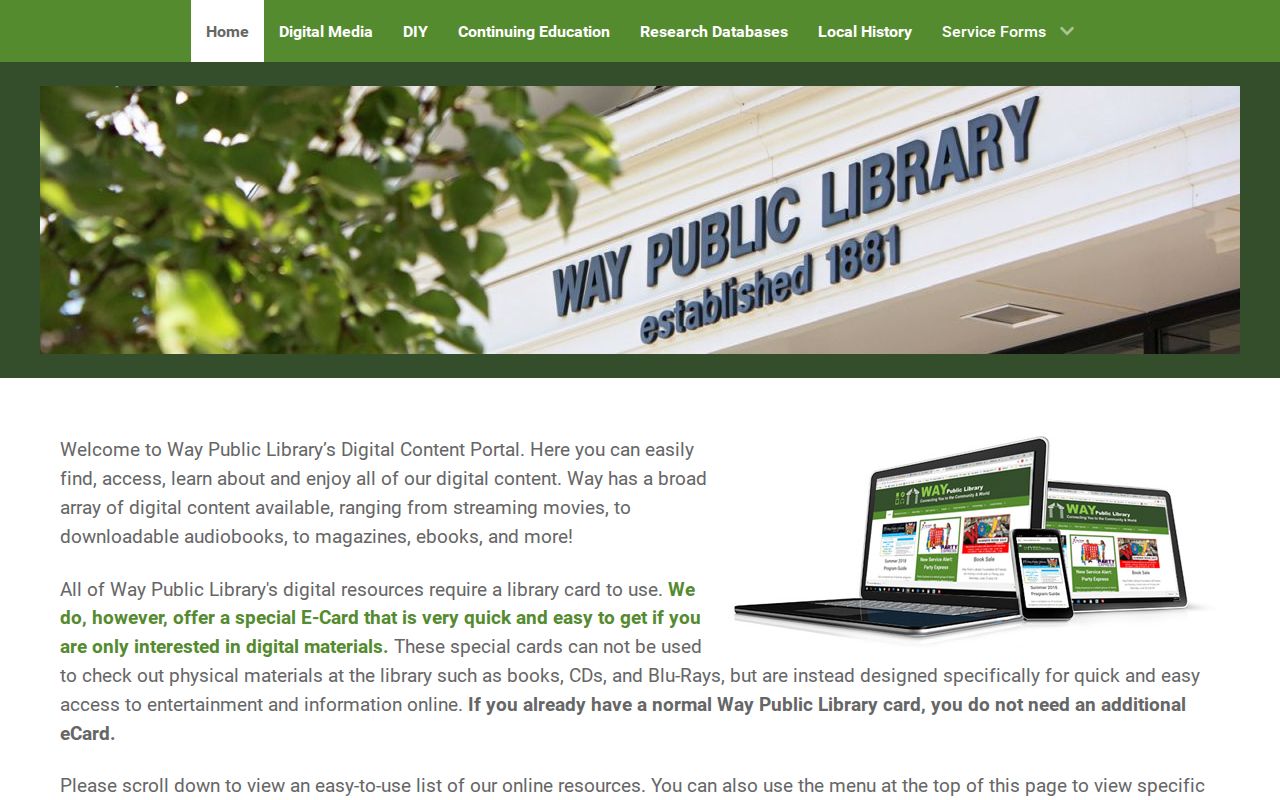
The gateway also points researchers toward local newspapers, Ancestry Library Edition access, and Ohio Memory resources.
Perrysburg House History Files
For an address question, a Way House History File can keep the work tied to the place rather than to a name alone. Request the file for the address along with maps, atlases, telephone directories, and newspaper-index references. This matters when an older street spelling, a rebuilt structure, or a changed parcel makes a modern search hard to match. The same file does not prove an owner or occupant for every year, but it can point to dated sources worth checking.
Telephone listings and property evidence serve different purposes. A listed subscriber may be an occupant, while a recorded deed may identify a party to a transfer. The historical collection helps place both beside a map, obituary, or local notice. For current address-keyed record work, use the Perrysburg Street Directory rather than treating old local material as a current roll.
Reading Perrysburg Directory Entries
A safe Perrysburg transcription records only what the exact volume prints. The research did not find a scanned local sample or an abbreviation key. Do not assume that a volume includes an occupation, spouse, ownership marker, reverse section, or even a residence field. Capture the page and the volume facts first, then use the entry as a lead for another dated source.
| Printed name | Copy initials, spelling, punctuation, and any cross-reference exactly. |
|---|---|
| Address | Keep the street suffix and whether the entry identifies a residence, business, rural route, or box. |
| Telephone detail | Record the number and exchange only when the volume prints them. |
| Other notation | Transcribe only the relationship, ownership, or other notation the specific volume actually prints. |
| Source details | Keep the title, publisher, year, page, and whether the work is alphabetic or address ordered. |
- Criss-cross directory
- An address-ordered directory, if the specific volume has one. Way's inspected sources do not verify a local criss-cross run.
- Householder index
- An index organized around the named household contact rather than every person at the address.
- Abbreviation key
- The volume's own explanation of marks and short forms. Photograph or copy it before interpreting an entry.
Pair the transcription with a newspaper, census, obituary, property, church, cemetery, yearbook, or House History source only when its date and facts match the entry.
Perrysburg Records in Ohio Memory
The Way Public Library Digital Archive in Ohio Memory is a searchable collection of Perrysburg history created with Ohio History Connection and supported by the Way Public Library Foundation. It is a useful online starting point for local photographs, documents, and other historical material. Item coverage varies, so a search result should be read at item level rather than treated as a complete local sequence.
The Ohio Memory collection appears in this Perrysburg city directory image.
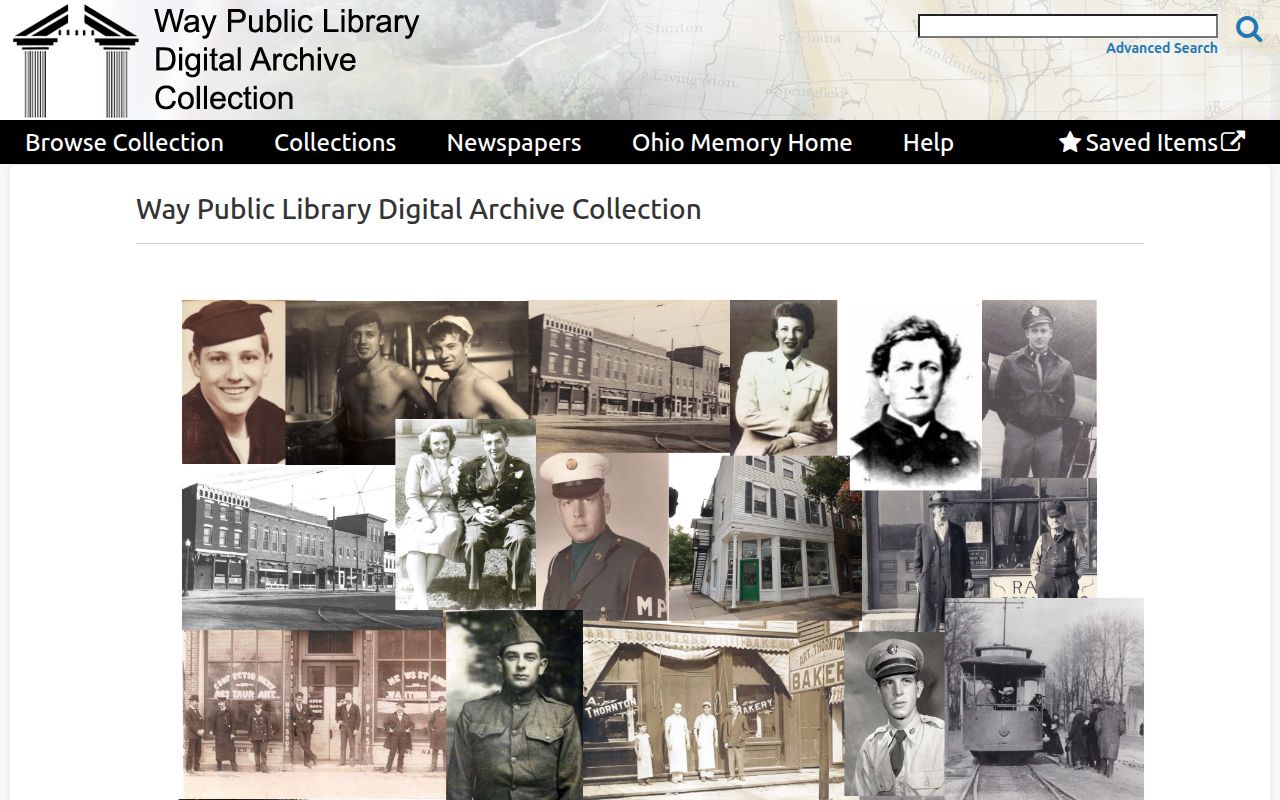
The archive offers a direct way to preserve a link to a digital item while the library collection remains the place to pursue unscanned material.
Perrysburg City Directories and Census
Tracing a Perrysburg household works best as a dated sequence, not as a continuous story. Federal census releases extend through 1950 as of the research date. Census is a household snapshot at its census date. Pair it with the nearest telephone-directory, newspaper, or House History File reference, then ask whether the address and names are consistent. A difference can signal a move, a different listed subscriber, a spelling change, or an unconfirmed match.
- Find the surname, spelling variants, and street in a Way telephone directory or newspaper index, and record the year and page.
- Check the House History File and maps or atlases for address continuity and earlier street wording.
- Pair the dated local result with the nearest released federal census, keeping the census date separate.
- Use an obituary, church record, or cemetery reference to test family relationships and dates.
- Move to Recorder and Auditor records only when the question is about a parcel or recorded ownership rather than a listed household.
A person missing from one volume may have moved, died, used another name form, lacked a listed service, or simply not appeared under that publisher's rules. Check the source before deciding which explanation fits.
Perrysburg Archival Research Routes
When the local collection does not settle a question, the BGSU Center for Archival Collections lists Wood County indexes for federal census years, naturalizations, marriages from 1820-1865, wills, estates, guardianships, cemetery inscriptions, delayed births, tax/property material, lawsuits, and atlases. Give the archive a surname, township, time period, and record type. That makes an archival request more usable than a broad request to locate a person.
The BGSU guide is shown in this Perrysburg city directory research image.
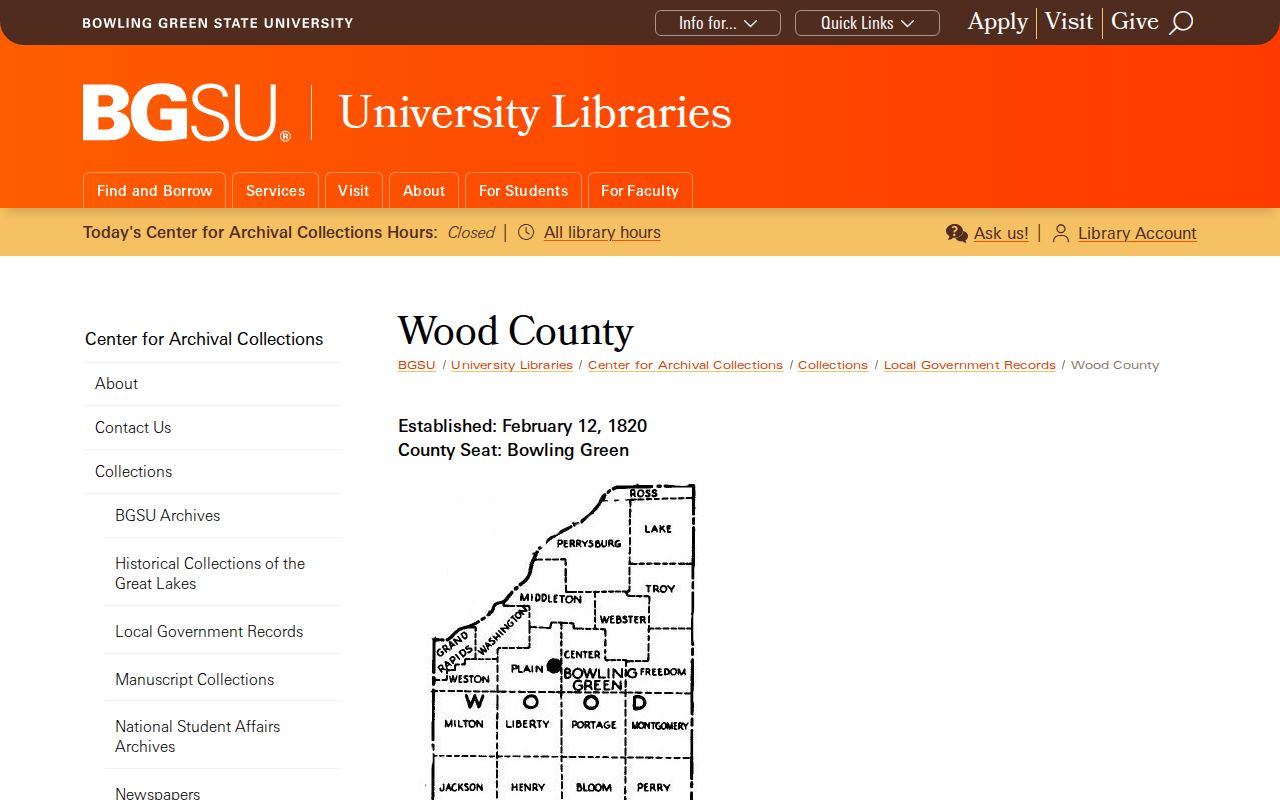
Its record-type indexes are a fallback where a person never appeared in a local telephone directory.
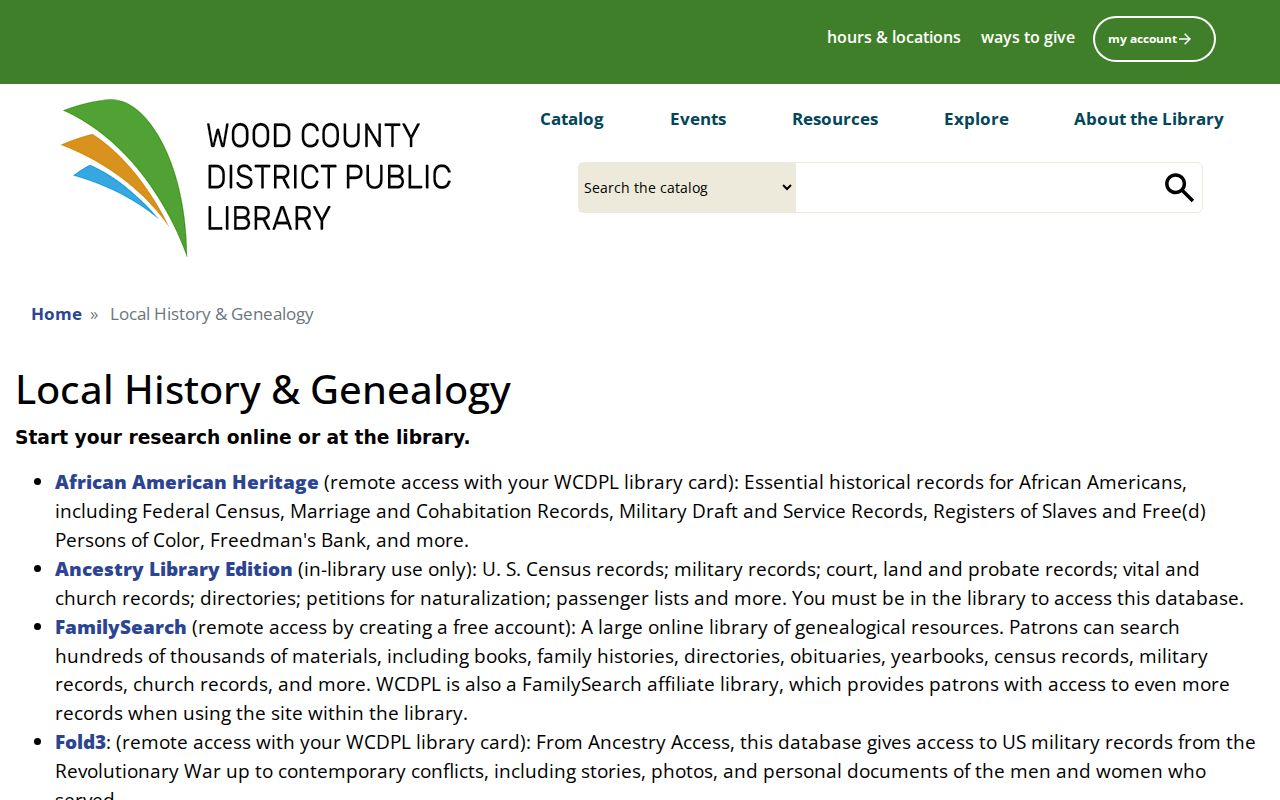
The Wood County District Public Library local-history service adds FamilySearch affiliate access, HeritageQuest for eligible cardholders, census resources, and Sanborn-map access. It supports Wood County context without claiming a distinct Perrysburg directory run.
The Wood County library resource page is shown in this Perrysburg city directory image.
Those regional tools can help connect a local entry to census, land, probate, or map evidence.
Perrysburg Historical Records Time Line
The surviving research supports a records timeline, not a claimed timeline of local publishers. It begins with a newspaper index in 1836 and is reinforced by an Exchange Hotel register beginning in 1865. Way Library began service in 1881, reached its current location in 1892, and later developed a searchable digital archive with Ohio History Connection. The result is a layered historical route rather than one master volume.
| 1836 | Way Library's local newspaper name-and-subject index begins. |
|---|---|
| 1865 | Exchange Hotel registers in the Way Collection begin. |
| 1881 | Way Library's original service opened. |
| 1892 | The library building began serving at its current location. |
| Later digital access | Way's local archive became searchable through its Ohio Memory collaboration. |
These dates do not fill the unverified gaps in printed telephone-directory volume years. A shelf or catalog inspection is still required for a particular year.
Perrysburg Genealogy Research Partners
The Wood County Genealogical Society resource list points to probate, obituary, census, Bible-record, newspaper, and Sanborn-map routes. Historic Perrysburg also directs genealogy research to Way Library's Local History Room and the Genealogical Society. Use those organizations for context and source leads, then retain the underlying record reference for any conclusion.
The Genealogical Society resource page is shown in this Perrysburg city directory image.
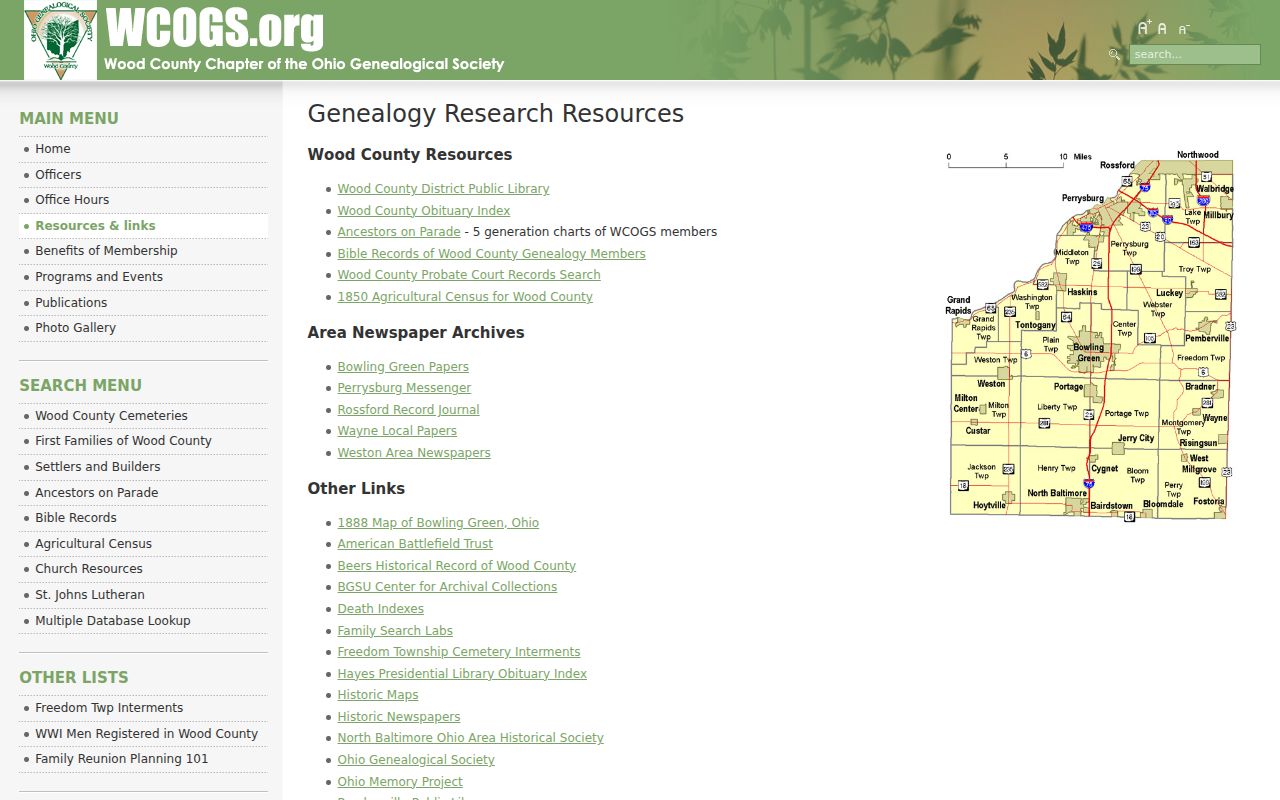
The wider Wood County network is especially helpful when a local telephone entry needs confirmation through probate, census, or obituary material.
Perrysburg Historical Record Limits
Historical directory research is strongest when it preserves the limits of each source. A telephone book can omit people without service or those listed under another name. An obituary may identify relatives but is not a property record. A census has a fixed date, and a map describes place rather than household membership. Records can also be missing because Perrysburg City, Perrysburg Township, and Wood County have different roles and changing boundaries.
Keep a source log with the title, page, collection, date, and the question each item answers. That habit protects against treating old directory evidence as current information and makes a family-history result easier to check later.